
 By Isle of Wight Observer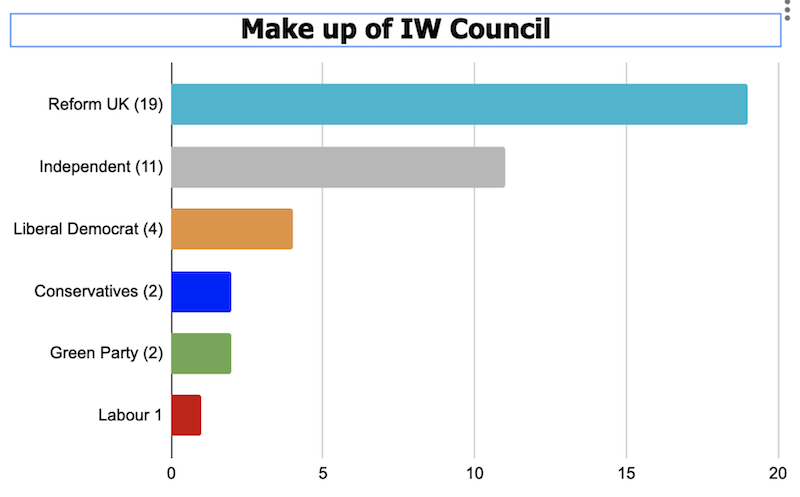

As votes were counted on Friday, it became clear that Reform UK delivered one of the most dramatic electoral shifts in the history of the Isle of Wight Council. Mirroring the party’s success across the country, Nigel Farage’s party came within a single seat of taking outright control of the 39‑member authority. Last Thursday’s local elections saw the party succeed across the Island, overturning long‑held seats, unseating the Leader of the Council, and reshaping the political balance.
The most symbolic moment of the day came in Ryde North West, where former Council leader, Phil Jordan, lost his seat to Reform’s new councillor, Reuben Loake. Mr Jordan was defeated by 62 votes.
Biggest and smallest majorities
The largest majority was in Cowes West & Gurnard, where Independent councillor Paul Fuller was re‑elected with a commanding 898‑vote lead with 1,173 votes, far ahead of Reform’s 275.
At the other end of the scale, the tightest contest of the entire election came in Shanklin Central, where Reform’s Stephen Reynolds won by a single vote. New Cllr Reynolds finished on 356, with the Conservative’s Michael Beston on 355, a margin so narrow it will doubtless be a cause of regret as the Tories review their disastrous campaign.
Reform’s advance and how close they came to control
Reform UK won 19 seats, just one short of the 20 required for an outright majority. Their candidates finished second in 17 wards, and in five places they were within 35 votes of victory.
Their gains stretched across the map, and in many divisions Reform overturned long‑established incumbents or surged past multiple opponents in crowded fields.
Other parties
The Conservatives endured a bruising result. Once the dominant force in Island politics, they lost 10 seats to Reform, and Bembridge to Cllr Mark Rochell of the Liberal Democrats. In several wards they were pushed into third or even fourth place. Only two Conservative councillors remain, Ed Blake and Matthew Price, and in many areas their vote was overtaken not only by Reform but also by Greens, Independents, and Liberal Democrats. As previously reported, they failed to submit nomination papers for their candidate in Brading & St Helens, leaving Cllr Jonathan Bacon to romp home with a 400 majority over his Reform opponent.
There are now 11 Independent councillors, four Liberal Democrats and two Green councillors.
Turnout: highs, lows and overall picture
Across the Island, 48,218 people went to the polling stations. The average turnout was 44.1 per cent, a notable rise from the 36.93 per cent recorded in 2021.
The highest turnout was in Brighstone, Calbourne & Shalfleet, where 55.68 per cent of electors voted. Bembridge, Chale, Niton & Whitwell and Nettlestone & Seaview also exceeded the 50 per cent mark
The lowest turnout was in Pan & Barton, at just 26.95 per cent, the only ward below 30 per cent.
What the new council looks like
Reform UK now sits as the largest group by a wide margin, but without the single extra seat needed for overall control. Independents remain a substantial presence, including several high‑profile re‑elections. The Liberal Democrats held key seats in Parkhurst & Hunnyhill and Ryde Appley & Elmfield. Alliance, Greens and the Very Broad Church Independents were reduced significantly. Labour held Cowes North but lost ground elsewhere.
What’s next
The next steps will involve the election of a new council leader, and chairman, and the formation of committees. With no party holding a majority, negotiations and voting agreements are likely to shape the coming weeks before the council meeting on June 26. Negotiations are still ongoing, but Cllr James Whelan, of Central Rural, has been elected as the leader of the Reform Group, the two Conservatives are forming their own group, as are the Liberal Democrats.
 Mal Butler